Broad General Education (S1-3)
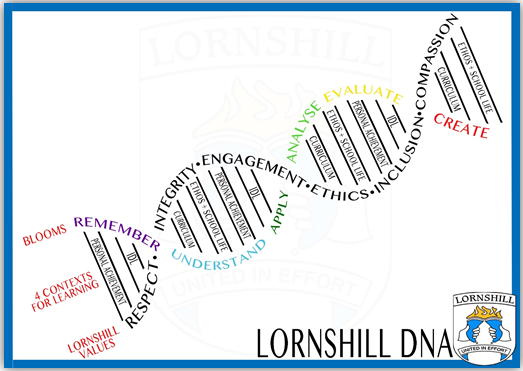
Curriculum for Excellence is divided into two phases: the broad general education and the senior phase. The broad general education begins in early learning and childcare and continues to the end of S3 (the third year of secondary school). Its purpose is to develop the knowledge, skills, attributes and capabilities of the four capacities of Curriculum for Excellence:
- Successful learners
- Confident individuals
- Responsible citizens
- Effective contributors
It is designed to provide the breadth and depth of education to develop flexible and adaptable young people with the knowledge and skills they will need to thrive now and in the future. It aims to support young people in achieving and attaining the best they possibly can.
Curriculum is defined as the totality of all that is planned for young people, through school and beyond. Young people’s learning should be planned for and experienced across the four contexts.
During the broad general education, children and young people should:
- achieve the highest possible levels of literacy, numeracy and cognitive skills;
- develop skills for learning, skills for life and skills for work;
- develop knowledge and understanding of society, the world and Scotland's place in it, much of which is now included in Learning for Sustainability;
- experience challenge and success so that they can develop well-informed views and the four capacities.
There are eight curriculum areas: expressive arts, health and wellbeing, languages (including English and modern languages), mathematics, religious and moral studies, sciences, social studies and technologies.
Each curriculum area is planned using experiences and outcomes. These describe the knowledge, skills, attributes and capabilities of the four capacities that young people are expected to develop.
Curriculum for Excellence Benchmarks set out clear statements about what learners need to know and be able to do to achieve a level across all curriculum areas.
Learning in the broad general education may often span a number of curriculum areas (for example, a literacy project planned around science and technology might include outdoor learning experiences, research and the use of ICT). This is likely to be in the form of themed or project learning which provides young people opportunities to show how skills and knowledge can be applied in interesting contexts.